Why Is Transformer Switch Gear Important?
Transformer Switch Gear plays a central role in moving electrical power safely from a transformer into a distribution system. It provides a controlled way to connect, disconnect, and protect equipment. Depending on the installation, it may include circuit breakers, fuses, disconnectors, protective relays, or a combination of these devices. The exact arrangement varies. A compact indoor unit and an outdoor substation assembly may serve very different operating conditions.
When a fault occurs, protective devices can detect abnormal current and interrupt the circuit. This helps limit damage to transformers, cables, and connected equipment. Switchgear also gives technicians a defined means of isolating sections for inspection or maintenance. That matters in real settings: a relay panel may be checked while nearby equipment remains in service, if the system design and approved procedures allow it. Safety depends on the whole installation, not one component.
Choosing suitable switchgear requires attention to voltage, load current, short-circuit ratings, protection coordination, and the surrounding environment. Dust, moisture, heat, and limited working space can all influence equipment selection and upkeep. Manufacturer documentation and qualified engineering review are essential. A rating that looks adequate on paper may not match actual fault conditions. That assumption deserves a second look. Routine inspections, testing, and clear operating records help reveal wear or settings that need review. Switchgear is not a guarantee against every failure, but correctly specified and maintained equipment can reduce risk and support reliable power distribution.
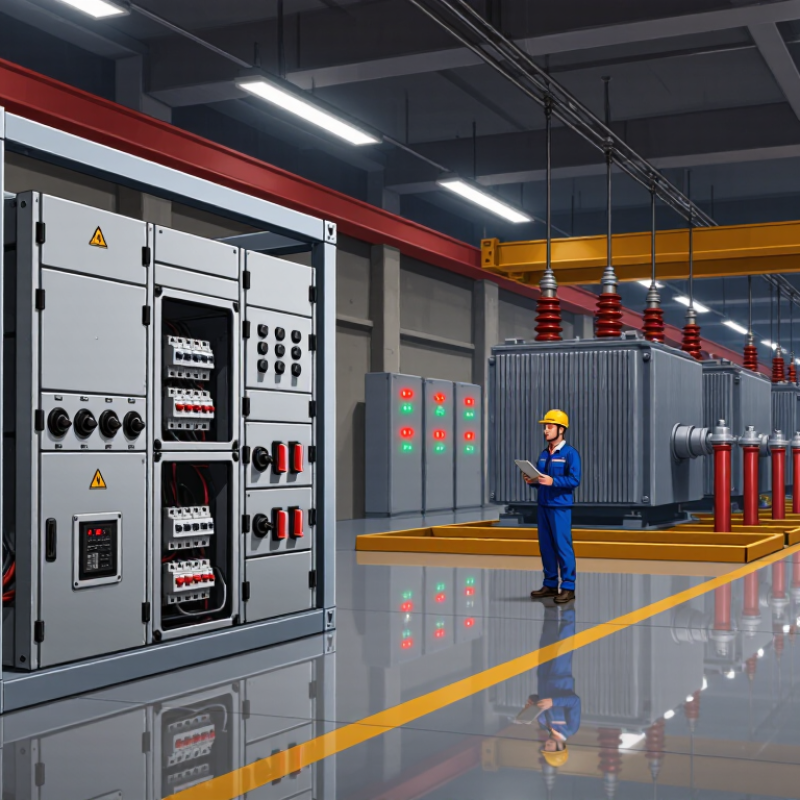
What Transformer Switchgear Is and How It Connects to a Power System
Why Is Transformer Switchgear Important?
Transformer switchgear is the set of devices that controls, protects, and isolates a transformer’s electrical connections. The transformer changes voltage; the switchgear manages the circuits around it. That distinction matters. A typical installation may include circuit breakers, disconnectors, protective relays, and current transformers. Together, these components connect the incoming supply to the transformer and its outgoing feeders.
On the high-voltage side, a circuit breaker can interrupt fault current, while disconnectors create a visible isolation point for maintenance. On the low-voltage side, switchgear distributes power to loads and can disconnect a faulty feeder. Relays monitor measured current and voltage, then signal breakers when readings exceed set limits. Engineers coordinate these settings with transformer inrush, fault levels, and grounding arrangements. Small parts, large consequences. In practice, coordination is not always neat; settings must reflect the actual network, not a generic diagram.
The wider need is growing. The International Energy Agency’s 2023 report, Electricity Grids and Secure Energy Transitions, says annual grid investment must rise from about USD 300 billion to over USD 600 billion by 2030. This is a grid-wide estimate, not a switchgear forecast. Still, it underscores why dependable connections matter: a transformer cannot serve downstream circuits safely if its switching and protection are poorly selected. Engineers should verify equipment ratings against site conditions, including available fault current and expected load changes.
| Connection Point | Equipment or Switchgear | Typical System Level | What It Does | Why It Matters |
|---|---|---|---|---|
| Incoming supply | Incoming circuit breaker and protection relays | Common sub-transmission and transmission levels include 33 kV, 66 kV, 132 kV, and higher, depending on the network. | Connects the incoming circuit to the substation bus and interrupts current when a detected fault meets the protection settings. | Helps isolate faults and allows the transformer circuit to be disconnected for maintenance. |
| Substation bus | Busbars, bus couplers, and associated switching devices | Voltage depends on the substation design; distribution substations commonly use medium-voltage buses such as 11 kV or 33 kV. | Provides a shared electrical connection between incoming circuits, transformer bays, and outgoing feeders. | Enables controlled switching and can provide alternative supply paths where the network design allows. |
| Transformer high-voltage side | Circuit breaker or other specified switching and protection arrangement | Selected to match the transformer winding and system voltage, for example 33 kV or 132 kV. | Controls and protects the transformer’s high-voltage connection; the exact arrangement depends on the system and transformer design. | Supports safe fault clearing and helps limit the impact of a transformer or connected-circuit fault. |
| Transformer | Power transformer (connected between switchgear sections) | Changes voltage between system levels, such as 132 kV to 33 kV or 33 kV to 11 kV; actual ratios vary by network. | Transfers electrical power between windings by electromagnetic induction and changes the voltage level. | Makes power suitable for onward transmission, distribution, or use by connected loads. |
| Transformer low-voltage side | Low-voltage or medium-voltage circuit breaker and protection | Common distribution outputs include 11 kV or 33 kV; local Distribution Transformers may supply 400/230 V in many systems. | Connects the transformer output to a downstream bus or feeder and provides switching and fault protection. | Allows downstream circuits to be isolated without necessarily disconnecting every other circuit on the network. |
| Outgoing distribution circuits | Feeder circuit breakers, fuses, or switch-fuse units, as appropriate | Distribution feeders commonly operate at medium voltage, such as 11 kV or 33 kV, or at low voltage near end users. | Routes power from the substation to other substations, distribution transformers, or loads. | Selective protection can disconnect an affected feeder while helping keep healthy parts of the system in service. |
| Isolation and safe access | Disconnectors, earthing switches, and interlocking arrangements | Selected for the circuit’s rated voltage and the applicable operating and safety requirements. | Provides isolation and, where designed for it, earthing of equipment during approved maintenance procedures. A disconnector is generally not intended to interrupt normal load current. | Helps establish a safe work condition when operated according to procedures and verified isolation requirements. |
| Protection and monitoring | Current transformers, voltage transformers, and protective relays | Instrument-transformer ratios and relay settings are engineered for the specific voltage, current, and protection scheme. | Supply measurement signals to protection and control equipment, which can command a circuit breaker to trip when specified conditions occur. | Enables fault detection and coordinated protection; settings must be designed and tested for the particular power system. |
| Typical voltage examples are illustrative, not universal ratings. Actual switchgear ratings, fault-interruption duties, protection settings, and connection arrangements must be selected to suit the system study, applicable standards, and site requirements. | ||||