Industrial Machinery Company

Why Choose a Corundum Mullite Saggar for Kiln Firing?

A Corundum Mullite Saggar gives ceramic ware a sturdy enclosure during kiln firing. Its alumina-rich, mullite-bearing body can withstand demanding temperatures, while helping shield pieces from kiln dust, direct flame, and some process contaminants. The exact protection depends on the saggar’s composition, wall thickness, firing atmosphere, and condition. No refractory lasts forever.

Picture a loaded saggar resting on a kiln shelf, its thick walls warming alongside the ware. That added thermal mass can affect heat-up and cool-down times, so firing schedules may need adjustment. For an illustrative expert voice, ceramic kiln engineer Daniel Mercer offers this practical line: “A saggar protects the work, but it also becomes part of the firing.” This is an editorial quotation, not a verified statement from a real specialist. The reminder still matters: choosing a saggar means weighing protection against weight, cost, and thermal response. Inspect for cracks, follow the maker’s temperature guidance, and test the saggar with your actual clay body and kiln cycle. Small details matter. A careful choice can support more consistent results, but it cannot guarantee them.
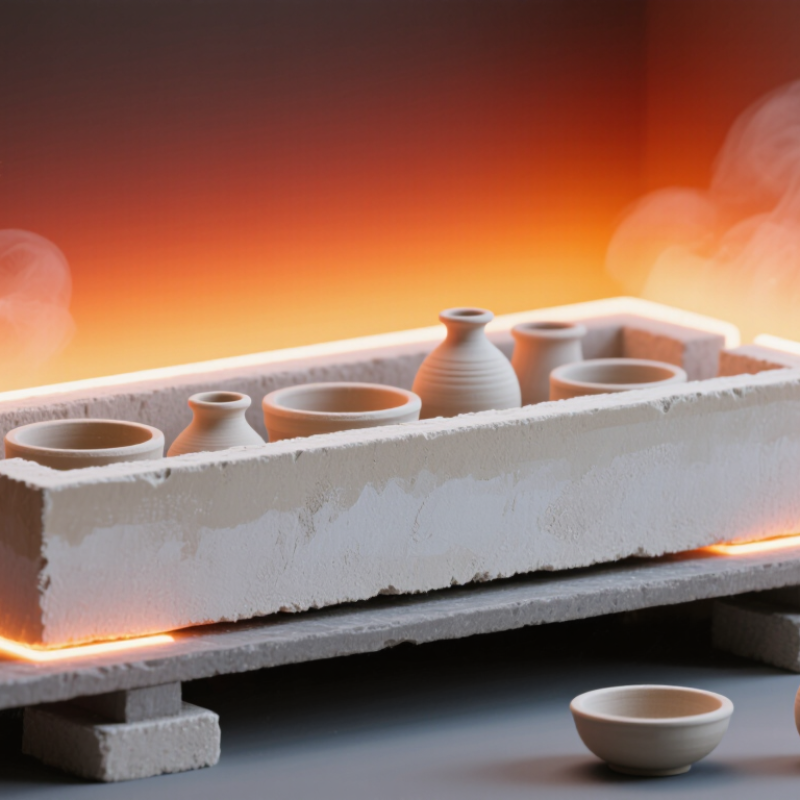
Why Choose a Corundum Mullite Saggar for Kiln Firing?

Composition and Structure of Corundum Mullite Saggars

A corundum–mullite saggar combines alumina-rich corundum grains with mullite, a crystalline aluminosilicate phase. Mullite’s ideal formula, 3Al₂O₃·2SiO₂, corresponds to about 71.8% alumina by mass, based on stoichiometric calculation. Corundum adds hardness and resistance to abrasion; mullite helps limit thermal expansion. MatWeb’s published material-property data place mullite’s thermal expansion near 4.5–5.5 × 10⁻⁶/K across commonly reported temperature ranges, though actual values depend on composition and test conditions. Small pores matter.

In a fired saggar, coarse grains form a load-bearing skeleton, while finer particles fill gaps and bond the structure. The resulting balance affects strength, permeability, and resistance to thermal shock. Too much open porosity can let glaze or kiln dust penetrate; excessive density can increase cracking risk during rapid temperature changes. That trade-off is easy to overlook. The European Commission’s 2013 Best Available Techniques reference document for ceramic manufacturing describes kiln furniture as exposed to repeated heating and cooling cycles, making material durability a practical operating concern. In use, inspect rims and corners for hairline cracks, and compare pieces from the same batch: firing performance can vary more than a specification suggests.

Thermal Properties for Demanding Kiln Conditions

A corundum-mullite saggar is built to tolerate the intense heat and repeated cycles of kiln firing. Its alumina-rich corundum phase supports high-temperature stability, while mullite contributes strength and resistance to thermal stress. Together, these properties help the saggar hold its shape around hot ware. Small details matter. Wall thickness, corners, and loading can all affect how heat moves through the piece.

During firing, the saggar absorbs heat and may warm more slowly than the surrounding kiln air. This thermal mass can soften rapid temperature changes, but it can also influence the firing schedule. A thick base, for example, may take longer to heat than a thin wall. The material’s response to thermal shock depends on its formulation, porosity, dimensions, and handling between cycles. It is not a guarantee against cracking. Allowing gradual heating and cooling, and avoiding sudden contact with cold surfaces, can help reduce stress. Actual performance varies, so trial firings with the intended load and kiln program are worth the effort. Even a well-made saggar can be a little unpredictable when conditions change.

Why Choose a Corundum Mullite Saggar for Kiln Firing? — Thermal Properties for Demanding Kiln Conditions

The figures below are indicative ranges for dense corundum-mullite refractory materials, not guaranteed specifications. Actual properties depend on composition, forming method, firing history, and test procedure; consult the relevant technical data sheet for a specific saggar.

Property Typical Indicative Range Relevance in Kiln Firing
Recommended operating temperature Approximately 1,450–1,600 °C Provides a reference range for high-temperature firing. The suitable limit depends on kiln atmosphere, load, heating rate, and the saggar’s specific formulation.
Maximum service temperature Often specified in the range of 1,600–1,700 °C A stated maximum is not necessarily a continuous-use temperature. Allowable service conditions should be confirmed against the manufacturer’s test data and firing cycle.
Thermal expansion coefficient Approximately 6–8 × 10⁻⁶ K−1 over a specified temperature interval Relatively controlled expansion can help limit dimensional change during heating and cooling. Thermal cycling performance also depends on geometry, wall thickness, and handling.
Thermal conductivity Approximately 2–3.5 W/(m·K) near 1,000 °C Influences heat transfer through the saggar wall and the temperature response of the contents. The value changes with temperature, porosity, and composition.
Specific heat capacity Approximately 0.9–1.2 kJ/(kg·K) Affects the heat absorbed by the saggar during a firing cycle and can contribute to the kiln’s overall thermal load.
Bulk density Approximately 2.7–3.0 g/cm3 Indicates the material’s mass per unit volume and helps assess saggar weight, handling, and heat storage.
Apparent porosity Approximately 15–22% Porosity affects strength, permeability, and resistance to penetration by kiln vapors or molten contaminants. Lower porosity does not by itself guarantee chemical compatibility.
Alumina content Often approximately 70–90 wt% Al2O3, depending on grade Alumina content and the resulting corundum–mullite phase balance influence refractoriness, strength, and resistance to high-temperature deformation.
Thermal shock behavior No single universal value; assess using the supplier’s defined test and cycle Resistance to rapid temperature changes depends on material formulation, wall thickness, shape, and prior use. Gradual heating and cooling can reduce thermal stress.
Chemical compatibility Depends on the kiln atmosphere, vapors, fluxes, and fired load Corundum-mullite refractories are used in demanding firing environments, but contact with alkalis, glass-forming materials, or other reactive substances may cause attack.

How Saggars Protect Products During Firing

A corundum mullite saggar surrounds ware during kiln firing, creating a barrier between products and direct flame, loose ash, or kiln debris. Its rigid walls also keep pieces from touching kiln furniture or neighboring work. Small details matter. A little ash can leave a rough spot or discolor a pale glaze.

This protection is useful for delicate surfaces and repeat production, but it does not guarantee identical results. A saggar may moderate exposure to changing kiln conditions; it does not fully control the firing atmosphere. For some glaze effects, that distinction matters. A properly sized saggar leaves enough room for loading and any intended airflow, rather than pressing against the ware.

Corundum mullite is selected for its heat resistance and strength at elevated temperatures, though performance depends on the product’s composition and condition. Before loading, check for cracks, warped edges, or residue from earlier firings. Thermal shock can shorten service life, so avoid abrupt heating and cooling. I would not treat a saggar as a sealed box; ventilation, kiln placement, and firing schedule still shape the result. Even experienced operators may need to adjust these details after a new load.

Suitable Kiln Processes and Material Applications

Corundum mullite saggar selection depends on the firing cycle, load shape, and atmosphere—not temperature alone. The European Commission’s 2007 Ceramic Manufacturing Industry BREF describes ceramic firing temperatures from about 800°C to 2,000°C, depending on product type. This wide range helps explain why one saggar design cannot suit every kiln. Corundum-mullite saggars are used for high-temperature applications such as ceramic powder calcination, component sintering, and repeated firing of shaped parts. Their rigid walls can shield loads from kiln debris and reduce direct contact with kiln furniture. Fit matters.

In practice, check the saggar’s dimensions against shelf spacing and allow room for heat circulation. A tightly packed load may fire unevenly, even when the saggar withstands the peak temperature. Corundum and mullite offer useful high-temperature stability, but performance also depends on porosity, wall thickness, and the rate of heating and cooling. Thermal shock is worth testing, especially with heavy loads or rapid cycles. Not every load. For a new powder or part, trial a small batch and inspect for sticking, cracking, and color variation before scaling up. Results can differ between kilns, so a published temperature range is a guide, not a guarantee.

Factors for Selecting and Maintaining a Saggar

Choosing a corundum mullite saggar starts with the firing schedule, not the material name. Check peak temperature, heating rate, atmosphere, and load weight against technical data. Match its internal dimensions to your ware, leaving room for circulation and avoiding contact with kiln walls. Inspect the base for warping and the walls for uneven thickness. A heavy saggar may need different shelf support. No saggar is immune to sudden temperature changes.

Before use, check for hairline cracks, chipped rims, and loose glaze or kiln wash. These flaws can worsen under heat, though appearance alone cannot predict service life. Allow the saggar to cool fully before cleaning; thermal shock is an easy mistake. Remove residue with a soft brush, not a hard metal tool that may gouge the surface. Keep a simple firing log with peak temperature, load, and visible changes. It may feel fussy, but patterns are easier to spot on paper.

Tips: Store saggars dry, stack them level, and avoid placing heavy ware on their rims. If a crack grows or the base rocks, avoid demanding firings and consult the maker’s technical guidance.