Top 10 KMnO4 Activated Alumina Suppliers Worldwide?
KMnO4 Activated Alumina is used in air-treatment systems to help remove certain contaminants, including hydrogen sulfide. Choosing a supplier takes more than comparing prices. Buyers need to examine potassium permanganate loading, alumina quality, particle size, packaging, and batch documentation. A small sample can reveal uneven color, excess dust, or inconsistent pellet dimensions. These details matter in a packed bed, where uneven material may affect airflow and performance.
This introduction uses a clearly illustrative expert voice, not a verified quotation: Dr. Elena Morris, a fictional adsorption-process specialist, might say, “A dependable media specification begins with the operating conditions, not the product label.” That distinction is useful. Humidity, inlet concentration, contact time, and vessel design can all shape a media choice. Supplier claims should therefore be checked against technical data sheets, test methods, and application-specific evidence. Ask how the product is stored and protected from moisture. Request representative samples when practical.
The Top 10 KMnO4 Activated Alumina Suppliers Worldwide? is a starting point for comparing manufacturers and distributors, not a universal ranking. Availability, technical support, shipping options, and documentation can vary by region and project. A supplier with broad reach may not offer the best fit for a small system. Conversely, a local source may have limited product data. No list can settle every question. Readers should verify specifications directly and assess them against their own process requirements. The ranking deserves review, too. A useful comparison makes its selection criteria visible and separates confirmed details from marketing claims.
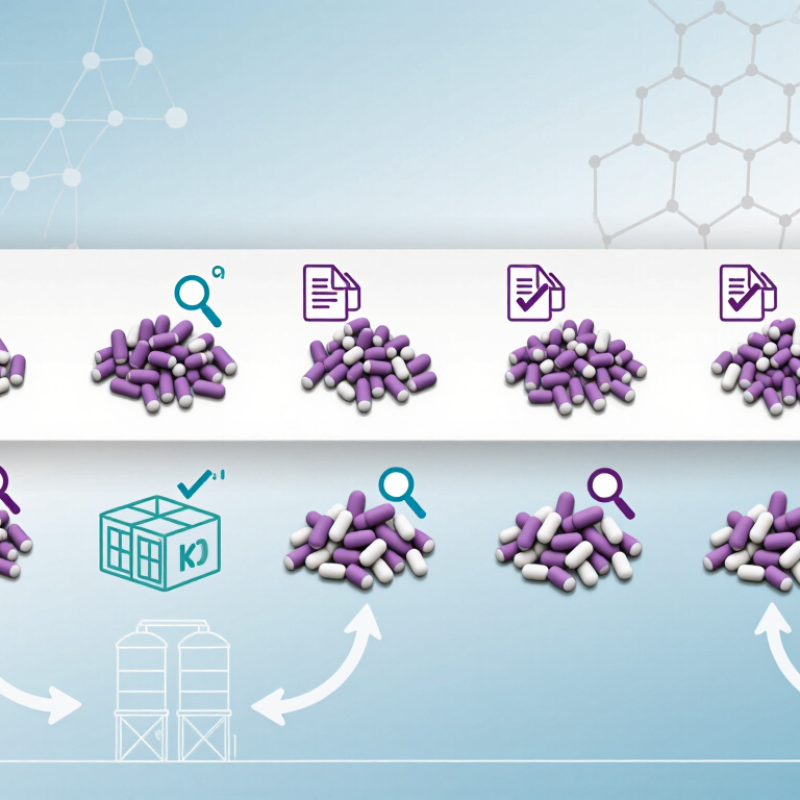
KMnO₄-Impregnated Alumina: Chemistry, Applications, and Gas-Removal Mechanisms
KMnO₄-impregnated alumina pairs porous alumina pellets with potassium permanganate, an oxidizing agent. The alumina provides a broad contact surface, while permanganate reacts with certain contaminants in passing air. Depending on the gas, target compounds can include hydrogen sulfide, some mercaptans, and selected odor-causing organics. Oxidation changes these compounds into less volatile products, which remain on or within the media. The exact reaction depends on contaminant chemistry and operating conditions.
This media is used in air-treatment systems, including ventilation for wastewater facilities, laboratories, and industrial spaces. In a duct, airflow must reach the pellets evenly; channeling can leave some media underused. Humidity, temperature, contaminant concentration, and contact time all affect performance. The mechanism is useful, but not magic. A media bed has finite capacity, and it will not remove every gas. Field testing and supplier data should guide selection.
Tips: Match the media to the specific gas, not just its odor. Check inlet concentrations, humidity, and airflow before sizing a bed. Track pressure drop and sample outlet air for breakthrough; odor alone can be misleading. Replace spent media according to test results and handling guidance.
Top 10 KMnO₄ Activated Alumina Suppliers Worldwide? - KMnO₄-Impregnated Alumina: Chemistry, Applications, and Gas-Removal Mechanisms
Supplier-neutral sourcing guide: the ten rows below compare product and verification criteria, not named companies or ranked suppliers. Product specifications vary by grade and manufacturer; request current technical data for each application.
| No. | Evaluation dimension | Established technical context | What to verify with a supplier |
|---|---|---|---|
| 1 | Active chemical | Potassium permanganate (KMnO₄) is an oxidizing agent. During contaminant removal, permanganate is consumed and reduced manganese compounds can form; the exact products depend on operating conditions. | KMnO₄ content, test method, batch tolerance, and whether the stated content is on an as-supplied or dry basis. |
| 2 | Alumina support | Porous activated alumina provides a high-area solid support for the oxidizing chemical. Its pore structure and surface properties influence gas access and usable capacity. | Support type, surface area, pore-volume data, and whether these are measured on the finished impregnated product. |
| 3 | Target contaminants | KMnO₄-impregnated media are used in gas-phase treatment for selected oxidizable contaminants, commonly including hydrogen sulfide, sulfur dioxide, nitrogen dioxide, and formaldehyde. Performance is contaminant- and condition-specific. | Independent or application-relevant test results for the exact target gas, inlet concentration, humidity, temperature, and gas velocity. |
| 4 | Removal mechanism | Removal generally combines adsorption or surface contact with chemical oxidation. The oxidant is progressively depleted, so breakthrough depends on contaminant loading and bed conditions. | Breakthrough curves, test endpoint definition, pressure-drop data, and evidence that test conditions match the intended system. |
| 5 | Granule size and shape | Granular media are used in packed beds and filter vessels. Particle size affects contact time, pressure drop, and the risk of channeling or entrainment. | Specified particle-size range, fines content, bulk density, and recommended bed depth and gas velocity. |
| 6 | Moisture and humidity | Water vapor can affect adsorption and reaction behavior. The direction and magnitude of the effect depend on the contaminant, formulation, and operating conditions. | Recommended relative-humidity range, moisture specification, and test data at the expected site humidity. |
| 7 | Working capacity and service life | Capacity is not a single universal value: it depends on the target contaminant, inlet concentration, humidity, temperature, residence time, and the chosen breakthrough endpoint. | Dynamic capacity under stated test conditions, expected replacement criteria, and any calculation assumptions used for service-life estimates. |
| 8 | Pressure drop and mechanical strength | Bed pressure drop depends on particle size, bed geometry, gas properties, and flow rate. Granule strength and attrition influence dust generation and long-term operation. | Pressure-drop curves for relevant flow conditions, crush or attrition data, and recommended vessel loading procedures. |
| 9 | Safety and handling | KMnO₄ is an oxidizer. The impregnated media should be handled and stored according to its safety data sheet, with attention to incompatible materials, dust, and spent-media hazards. | Current safety data sheet, storage and transport guidance, disposal information, and applicable regulatory classifications. |
| 10 | Quality documentation and supply | A technically suitable product also needs consistent batch quality, traceable documentation, and packaging appropriate to storage and transport. | Certificate of analysis, lot traceability, packaging details, shelf-life or storage conditions, sample availability, and delivery lead time. |