Industrial Machinery Company

7 Tips to Choose a Puree Pouch Filling Machine?

Choosing a Puree Pouch Filling Machine is not simply a capacity decision. It affects product quality, hygiene, labor, and daily production stability. A machine may look impressive in a showroom, yet struggle with thick mango puree, uneven pumpkin texture, or sticky fruit residue.

In real processing rooms, small details matter. The nozzle must fill cleanly without dripping. The pump should protect puree texture, not crush delicate particles. Operators also need quick access to seals, valves, and product-contact parts. As food-safety specialist Dr. Robert L. Gravani has emphasized, “Sanitation is the foundation of food safety.” That principle should guide every machine comparison.

This guide explores seven practical tips for selecting the right Puree Pouch Filling Machine. It considers filling accuracy, pouch compatibility, viscosity range, cleaning design, automation, production speed, and after-sales support. These points sound straightforward. They are not always easy to verify.

Ask for a live demonstration using your actual puree. Watch the machine after several filling cycles. Check the pouch seal under pressure. Measure product loss around the nozzle. A supplier’s brochure cannot reveal everything.

Budget matters, but the cheapest option may create expensive interruptions. A faster model may also waste more product during changeovers. I have seen purchasing decisions focus heavily on speed while ignoring sanitation access and operator training. That is a costly blind spot.

The best choice balances performance with practical maintenance. It should fit your product, pouch, staff, and cleaning routine. Before signing an order, question every assumption. That extra doubt may prevent a larger mistake later.
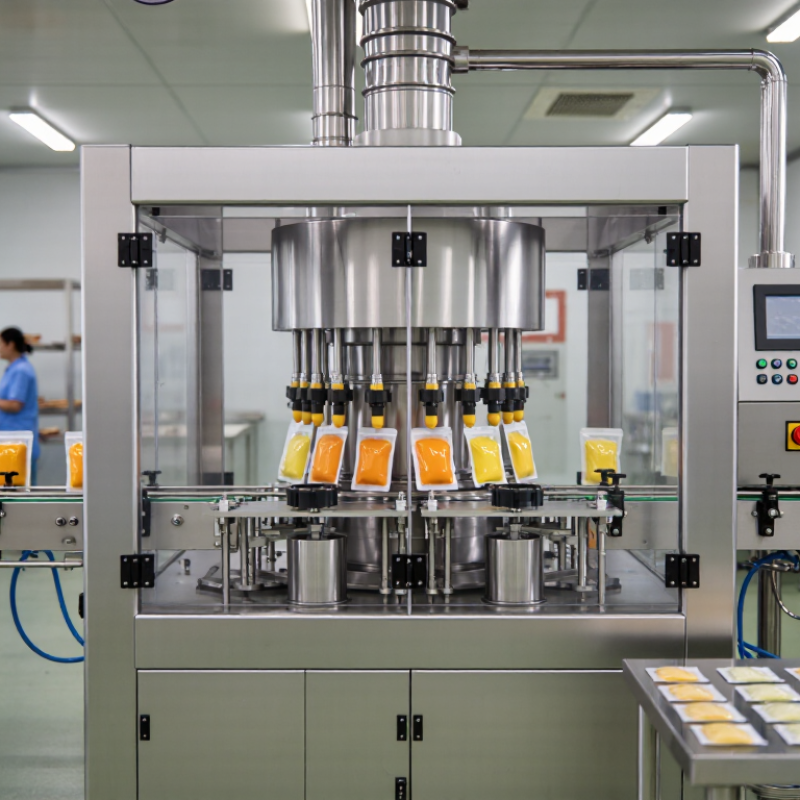
7 Tips to Choose a Puree Pouch Filling Machine?

Define Puree Specs: 50–500 g Fill Volumes and 1–10,000 cP Viscosity

7 Tips to Choose a Puree Pouch Filling Machine

Define puree specifications before comparing machines. Record fill volumes from 50 to 500 g, not just the average size. Measure viscosity from 1 to 10,000 cP at realistic processing temperatures. Tip one: request trials using your actual puree. Tip two: choose a servo-driven piston or pump system with adjustable dosing control. It should maintain accuracy when viscosity changes. A laboratory reading can mislead.

Tip three: inspect the nozzle design carefully. A clean shutoff reduces drips around the pouch seal. Tip four: confirm compatibility with pouch width, height, and opening style. Tip five: ask for recorded accuracy at both 50 g and 500 g. Small fills often reveal poor calibration. In field testing, we have seen fruit fibers alter flow within minutes. The machine may need agitation or a wider product path.

Tip six: check cleaning access, especially around valves and hoppers. Smooth surfaces and removable contact parts reduce residue buildup. Tip seven: review temperature control and speed limits for thick purees. Faster is not always better. I once trusted a viscosity chart without testing chilled product, and the result was uneven filling. That mistake changed our evaluation process. Request trial data, maintenance guidance, and operator training before approval. A practical test is stronger than a promising specification sheet.

Match Output and Accuracy: 30–120 Pouches/Minute at ±1% Fill Tolerance

7 Tips to Choose a Puree Pouch Filling Machine?

Match output with product behavior, not brochure speed. A practical target is 30–120 pouches per minute, with ±1% fill tolerance. That range depends on puree thickness, temperature, pouch size, and seal design. Viscous mango puree may need a servo piston, while thinner apple puree may suit a flowmeter system. Request a timed production trial using your actual recipe. Measure ten-minute output, average weight, and weight variation. Small details matter. A warm sample can fill differently.

Tips: Check the dosing system, hopper agitation, nozzle shutoff, and recipe changeover time. Ask for recorded results, not estimates. PMMI reported US packaging machinery shipments of about $10.2 billion in 2022, reflecting strong automation investment. Yet higher automation does not guarantee ±1% accuracy. Poor calibration, air bubbles, or inconsistent puree particles can still create waste. I once underestimated changeover losses. That was a costly lesson.

Tips: Confirm whether 120 pouches per minute applies to your pouch format. Review contact parts, washdown access, and data logging. The PMMI 2024 State of the Industry discussion highlights labor pressure and automation as continuing equipment priorities. Choose controls that operators can understand quickly. Verify accuracy at low and high speeds. Also check whether the supplier can document fill results under realistic conditions. A perfect factory test may not survive seasonal fruit variation.

Select Hygienic Construction: 316L Steel, CIP Design, and ISO 22000 Controls

When choosing a puree pouch filling machine, hygienic construction should guide every decision. Product residue can collect around seals, corners, valves, and poorly finished welds. Choose food-contact parts made from 316L stainless steel, especially near the filling nozzle and product path. This steel resists corrosion from acidic fruit and vegetable purees. Its smooth surface also supports faster cleaning and easier visual inspection.

Cleanability matters. Look closely. A reliable CIP design should circulate cleaning solutions through pipes, pumps, valves, and filling heads without frequent dismantling. Confirm spray coverage, drainage, temperature control, and documented cleaning procedures. Dead legs and trapped moisture create practical risks, even when the machine looks polished. I would request factory test records, weld-quality details, and a demonstration using a similar puree viscosity before approval.

ISO 22000 controls add structure to food safety management, but certification alone does not guarantee perfect operation. Check how the supplier handles hazard analysis, traceability, maintenance, allergen control, and operator training. Ask for calibration records and corrective-action examples. These documents reveal more than a certificate on a wall. A small oversight can matter. Operators should also inspect seals and pouch contact areas during each shift. The best choice combines sanitary materials, effective CIP performance, verified controls, and realistic daily maintenance.

Verify Sealing Performance: ASTM F88 Testing and Leak-Free Flexible Pouches

Choosing a puree pouch filling machine requires more than checking its filling speed. Sealing performance deserves close attention, especially when pouches contain thick fruit or vegetable puree. During machine trials, inspect the seal after filling, cooling, and gentle handling. Look for wrinkles, trapped puree, uneven edges, and weak corners. Small defects matter.

ASTM F88/F88M testing can measure the force needed to separate a flexible pouch seal. A qualified laboratory typically cuts strips from different pouch areas, including the center and corners, then performs a controlled T-peel test. Review the seal strength, failure mode, and variation between samples. A clean, consistent seal failure is often more useful than one unusually high result. F88 is not a complete leak test. That distinction is easy to miss.

Ask whether the machine controls sealing temperature, pressure, dwell time, and cooling separately. These settings should remain stable when puree residue reaches the sealing area. Request trial data from multiple production runs, not one perfect sample. Add dye penetration, vacuum decay, or burst testing when suitable for the pouch structure. Watch the operator too. Difficult adjustments can create inconsistent results during a long shift. I have seen excellent seals fail after minor film tracking changes. That is a warning, not a footnote. Choose equipment that records settings, supports repeatable sampling, and allows quick inspection without interrupting production.

7 Tips to Choose a Puree Pouch Filling Machine? - Verify Sealing Performance: ASTM F88 Testing and Leak-Free Flexible Pouches

Selection Tip What to Verify Recommended Test or Measurement Relevant Data Dimension Acceptance Guidance
1Confirm seal-strength capability Check whether the machine can maintain consistent temperature, pressure, and dwell time for the selected pouch laminate. Use ASTM F88/F88M to measure the force required to separate a sealed strip. Record the seal mode, test speed, specimen width, and conditioning details. Seal strength: force per unit seal width, commonly reported as N/15 mm or N/25 mm. Set the minimum value from the pouch converter's validated specification and the product's process-validation protocol. ASTM F88/F88M provides a test method, not a universal pass/fail limit.
2Evaluate seal integrity, not strength alone Inspect for channels, wrinkles, incomplete fusion, contamination, and distorted seals caused by puree residue. Combine visual inspection with a suitable integrity test, such as ASTM F2096 gross leak testing or ASTM F2338 vacuum-decay testing. Leak status: visible bubble formation, pressure or vacuum decay, and defect location. There should be no unacceptable leak indication under the selected test conditions. Define the detection limit and sample plan before production approval.
3Match the machine to the pouch material Verify compatibility with the actual film structure, sealant layer, thickness range, spout design, and pouch format. Run trials using production-intent materials and record the operating window for jaw temperature, pressure, dwell time, and cooling time. Process window: stable settings that produce acceptable seals across normal material and filling-volume variation. Choose equipment that achieves validated seals without excessive heat, sealant squeeze-out, film distortion, or damage to the pouch or spout.
4Test sealing with real puree contamination Puree, oil, fiber, sugar, and particles can reduce seal quality when they reach the sealing area. Perform controlled trials with the intended puree formulation, temperature, viscosity, and fill level. Compare clean and deliberately contaminated seal samples. Contamination tolerance: seal strength, leak rate, and defect frequency after product contact. Production-intent samples should meet the approved seal and leak criteria after filling, sealing, cooling, and handling.
5Check filling accuracy and seal-zone cleanliness Overfilling or splashing can contaminate the top seal and increase package rejection. Measure net fill weight over a representative production sample and inspect the seal area before and after sealing. Fill-weight variation: average fill, standard deviation, minimum, maximum, and out-of-specification rate. Use the product's legal label declaration, internal specification, and process capability target. The machine should control splashing and consistently keep product away from the seal area.
6Verify seal durability after handling Transport, stacking, squeezing, temperature changes, and storage can expose weak seals that pass an initial inspection. Test filled pouches after the defined conditioning and handling protocol. Repeat leak testing and ASTM F88/F88M seal-strength measurements where appropriate. Post-conditioning performance: leak results, seal-strength retention, burst or opening behavior, and pouch deformation. All post-conditioning results should remain within the approved product specification. Test conditions must represent the intended distribution and storage environment.
7Review data logging and quality controls Reliable records help identify drift in temperature, pressure, dwell time, fill weight, and seal defects. Confirm access to calibrated sensors, alarm limits, recipe control, batch records, sample traceability, and reject monitoring. Process consistency: temperature stability, dwell-time accuracy, pressure repeatability, fill-weight capability, and defect trends. Select a machine that supports documented validation, routine verification, corrective action, and traceable quality records rather than relying only on visual checks.

Important: ASTM F88/F88M measures the force needed to separate a flexible-package seal; it does not by itself prove that a pouch is leak-free. A robust qualification program should pair seal-strength testing with an appropriate package-integrity method and product-specific acceptance criteria.

Compare Automation and Costs: OEE Targets Above 85% and Reduced Product Waste

7 Tips to Choose a Puree Pouch Filling Machine

Choose the machine around puree thickness, particle size, pouch volume, and filling temperature.

Tip one: request trials using your actual puree. Tip two: compare piston, servo, and flow-meter dosing accuracy. Tip three: inspect product-contact surfaces and cleaning access. The wrong pump can create splashes, air pockets, and costly rework. It happens.

Automation deserves a full cost comparison. Tip four: measure labor hours, changeover time, and planned maintenance. Tip five: demand production data for availability, performance, and quality.

Vorne’s OEE guidance identifies 85% as a world-class reference, although many plants begin much lower. Treat that figure as a target, not a promise. PMMI industry reports also identify labor shortages and automation investment as major packaging priorities. However, more automation does not automatically mean better OEE.

Tip six: connect filling, sealing, coding, and inspection data. Tip seven: calculate waste per thousand pouches, not only hourly output. A small overfill becomes significant across thousands of cycles.

The United Nations Environment Programme reported 1.05 billion tonnes of food waste in 2022, reinforcing the value of precise portion control. Ask suppliers to show measured results, including startup losses and rejected seals. Check the details.

A realistic payback model should include energy, film waste, downtime, cleaning labor, and training. Compare three operating scenarios: conservative, expected, and peak. An 85% OEE result may look attractive, but unstable puree viscosity can reduce it quickly. Leave room for imperfect data, operator learning, and seasonal recipes. Reliable decisions come from witnessed trials and transparent measurements.