How to Choose a Chlorine Analyser for Your Needs?
Choosing a Chlorine Analyser for your needs starts with the water, process, and decision you need to protect. A drinking-water plant may monitor residual disinfectant across a long distribution network. A food-production line may need quick checks beside a wash tank. The right instrument depends on the sample, required measurement range, response time, and operating conditions—not just its advertised accuracy.
The WHO/UNICEF Joint Monitoring Programme’s 2023 report estimated that 2.2 billion people lacked safely managed drinking-water services in 2022. That figure underlines why dependable monitoring matters. WHO’s Guidelines for Drinking-water Quality emphasize effective disinfection and maintaining an appropriate chlorine residual throughout distribution. The required target varies with the system and local requirements. Small changes matter.
Before comparing models, confirm whether you need free chlorine, total chlorine, or both. Check the expected concentration, sample temperature, pH, and potential interference from other substances. For example, a portable colorimeter may suit scheduled field checks, while an online analyser can provide continuous readings for process control. Consider calibration, cleaning, reagent use, data logging, and the time staff can realistically spend on maintenance. A meter can be accurate and still be wrong for the job. That is easy to overlook. Manufacturer specifications are useful, but they should be checked against your actual sample and operating routine. A careful choice balances measurement performance with upkeep, verification, and clear, usable results.
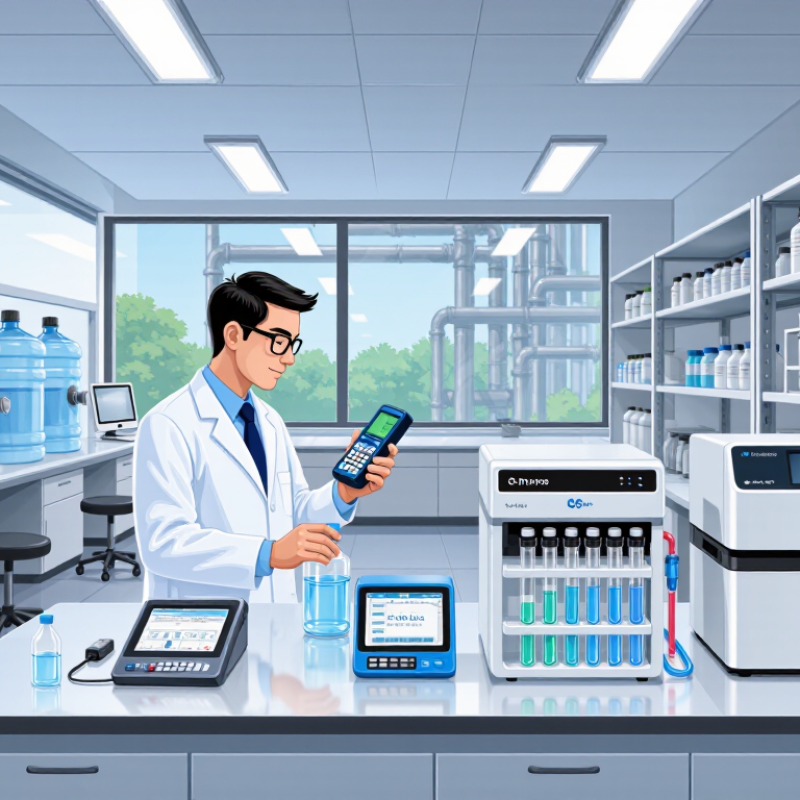
Define the Measurement Goal and Chlorine Application
Start by defining what “chlorine” means in your process. Free chlorine, combined chlorine, and total chlorine describe different measurements, so the analyser must match the parameter used for control or reporting. For a drinking-water line, you may need a stable free-chlorine residual. In a cooling system, total chlorine or another process-specific measurement may be more useful. Check the expected concentration range, too. An instrument designed for trace residuals may not suit a concentrated process stream.
Then consider where and how the reading will be used. A continuous analyser near a treatment outlet can show changes quickly, while occasional grab samples may suit a small system with steady demand.
Sampling location matters: chlorine can react with pipe deposits or contaminants before reaching the sensor. Note water temperature, pH, suspended solids, and flow conditions, since these can affect measurement or maintenance. A clean-looking sample line is not always representative.
Compare the analyser’s response time and maintenance needs with the actual operating routine, and confirm its readings against a suitable reference method during commissioning. If operators need to adjust dosing from the result, dependable readings matter more than a long feature list.
One detail is often missed: the best measurement point may change as the process changes.
Identify the Chlorine Species and Measurement Range
How to Choose a Chlorine Analyser for Your Needs?
Identify the Chlorine Species and Measurement Range
Choose the measurement before choosing the analyser. Free chlorine measures hypochlorous acid and hypochlorite ions; total chlorine also includes combined chlorine, such as chloramines. These readings are not interchangeable. A plant tracking disinfection may need free chlorine, while a system using chloramines may need total chlorine or a separate combined-chlorine measurement. Check that the analyser’s method reports the species your process actually controls.
Set the range around routine values, then allow room for peaks. The WHO Guidelines for Drinking-water Quality (2022) describe a free chlorine residual of at least 0.5 mg/L after 30 minutes of contact at pH below 8, and at least 0.2 mg/L at delivery. These are guidance values, not universal setpoints. For a drinking-water line, a low-range instrument may resolve small residual changes better; a wider range may suit samples with occasional high readings. One detail is easy to overlook: a broad range can hide small changes near the target.
Tips: Specify units as mg/L “as Cl₂,” confirm the analyser’s stated species, and compare results with a suitable reference method. Check a real sample; clean-looking water can still contain a measurable residual.
How to Choose a Chlorine Analyser for Your Needs? — Identify the Chlorine Species and Measurement Range
| Measurement need | Species or result | Typical selectable range* | Common measurement approach | Selection considerations |
| Routine disinfection control | Free chlorine: hypochlorous acid (HOCl) and hypochlorite ion (OCl⁻) | Commonly 0–2 or 0–5 mg/L as Cl₂ | DPD colorimetric or amperometric | Choose a range that covers normal values and expected peaks. Amperometric readings can be affected by pH, temperature, and flow; check whether pH compensation is needed. |
| Monitoring chlorine after chloramination or where combined residual matters | Total chlorine: free chlorine plus combined chlorine | Commonly 0–2 or 0–5 mg/L as Cl₂ | DPD colorimetric with the appropriate total-chlorine reagent; some analyzers use amperometric methods | Confirm that the instrument measures total chlorine, not free chlorine alone. Reagent handling and sample-contact time may affect automated systems. |
| Estimating chloramine residual | Combined chlorine, generally calculated as total chlorine minus free chlorine | Use ranges that cover both the total- and free-chlorine measurements | Paired free- and total-chlorine measurements | This difference is an estimate of combined chlorine; it does not identify individual chloramine species. Small differences can be affected by the uncertainty of both measurements. |
| Low-residual or low-level monitoring | Free or total chlorine at low concentrations | A low-range option may be 0–0.5 or 0–1 mg/L as Cl₂ | Low-range colorimetric or suitably specified amperometric analyzer | Check the stated detection limit, resolution, and accuracy near the intended operating value. Avoid selecting a range so wide that normal readings occupy only a small portion of the scale. |
| Higher residuals or variable process concentrations | Free or total chlorine, depending on the process requirement | Ranges such as 0–10 mg/L as Cl₂ may be available; higher ranges are instrument-specific | Analyzer configured for the required range, or a validated sample-dilution arrangement | Verify the maximum concentration and over-range behavior. Do not assume a low-range residual analyzer is suitable for concentrated hypochlorite or chlorine solutions. |
*Ranges are illustrative examples, not universal specifications. Actual ranges, detection limits, and performance depend on the analyzer, method, sample conditions, and required measurement standard. Concentrations are expressed as mg/L chlorine (Cl₂) equivalent.
Compare Analyzer Technologies and Sampling Methods
How to Choose a Chlorine Analyser for Your Needs?
Compare Analyzer Technologies and Sampling Methods
Choosing a chlorine analyser starts with the water and the decision it must support. Amperometric sensors provide continuous readings without routine color reagents, but changing flow, pH, or temperature can shift results. Colorimetric analysers measure a reagent-driven color change, often using the DPD method. They can suit controlled sampling, though reagent handling and cleaning add work. The US EPA’s Method 334.0 describes online chlorine measurement and comparison with grab-sample DPD results. Neither technology is universally better. The choice is rarely neat.
Tips: Check sample flow, temperature, and pH at the installation point. Keep the sample line short and steady; a long line can delay readings. Compare online results with a properly collected grab sample during commissioning and routine checks.
Sampling details matter as much as the sensor. A sidestream sample is easier to service, but stagnant water or poor flow can distort readings. In-situ measurement avoids some tubing delays, though access and maintenance may be harder. WHO’s Guidelines for Drinking-water Quality cite 0.2 mg/L free chlorine as a residual at delivery, while noting treatment conditions affect targets. Treat that figure as context, not a universal setpoint. Record the sampling location and method; otherwise, two accurate instruments may still disagree.
Assess Site Conditions, Accuracy, and Maintenance Needs
How to Choose a Chlorine Analyser for Your Needs?
A chlorine analyser should suit the water, the installation, and the people maintaining it. Start by checking sample temperature, pressure, flow, and expected chlorine range. A unit installed beside a treatment tank may face splashing, vibration, and changing ambient temperatures. Sites get messy. Confirm that the sampling line delivers a steady, representative sample without long delays or trapped air. If water quality varies, ask how turbidity, pH, or other chemicals could affect the measurement.
Accuracy needs depend on how the reading will be used. Compare the analyser’s stated range, resolution, and repeatability with your process limits, not just its headline accuracy. A reading that looks precise can still be unreliable if calibration is overdue or sample flow is unstable. Check whether the instrument supports a practical calibration routine and whether its output can be verified against a trusted reference method. Keep records. They help reveal drift before it becomes a process problem.
Maintenance can decide whether a technically suitable analyser works well over time. Find out how often sensors, reagents, filters, or tubing need attention, and whether replacement parts are easy to obtain. Consider who will perform those tasks during a busy shift. A complicated procedure may be missed, even by careful staff. That is worth admitting. Ask for a demonstration using your actual sample conditions, then review the cleaning steps, alarm handling, and service access before choosing. A few minutes saved during installation may cost more later.
Select an Analyzer That Meets Operational and Regulatory Requirements
Choosing a chlorine analyser starts with the decision it must support: disinfection control, distribution monitoring, or compliance records. These jobs may require different measurements. Confirm whether your operating plan calls for free chlorine, total chlorine, or both; confusing the two can obscure important process changes. The World Health Organization’s Guidelines for Drinking-water Quality (2022) cite 0.2 mg/L as a minimum free-chlorine residual at the point of delivery. Treat this as guidance, not a replacement for local requirements. Check the expected measurement range, reporting interval, alarm limits, and data-retention needs before comparing instruments.
Match the analyser to the actual sample and site conditions. A warm, bubbly sidestream can behave differently from a stable laboratory sample. Check temperature and pH limits, response time, cleaning needs, calibration frequency, and whether staff can maintain the sampling line. Small details matter. For U.S. systems, the EPA’s National Primary Drinking Water Regulations set a chlorine maximum residual disinfectant level of 4.0 mg/L as Cl₂. That is a regulatory ceiling, not a target for every process. No analyser eliminates sampling errors. Review its readings against a trusted reference method during commissioning, then keep checking them under real operating conditions. A precise display can still give false confidence if the sample flow is poor or calibration records are incomplete.