Industrial Machinery Company

2026 How to Choose the Right Connector Hose Pipe

Choosing a Connector Hose Pipe in 2026 is not just a matter of matching diameter and price. The wrong assembly can leak, restrict flow, or wear prematurely. Grand View Research estimated the global industrial hose market at about USD 13.3 billion in 2023, with projected growth through 2030. That market figure signals broad industrial demand, but it does not tell you which hose suits your system. It is context, not a buying rule.

Start with the actual service conditions. Record the fluid, operating and peak pressure, temperature range, flow rate, bend radius, and exposure to abrasion or weather. A hose carrying hot oil beside a vibrating pump needs different materials and reinforcement from one carrying water at steady pressure. Check the manufacturer’s compatibility charts and assembly instructions; a fitting that looks right may still be unsuitable. Standards can help frame testing: ISO 1402 covers hydrostatic testing of rubber and plastics hoses, while ISO 6803 specifies hydraulic-fluid-power impulse testing without flexing. Neither standard alone proves that a product fits your application. Small details matter. So does the installation. A tight bend, twisted hose, or mismatched fitting can undermine an otherwise sound selection. I would also question vague claims such as “heavy duty” unless the supplier provides pressure ratings, temperature limits, and traceable product information. Gather those details before comparing quotes, and leave room to review the choice when real operating conditions differ from the assumptions.
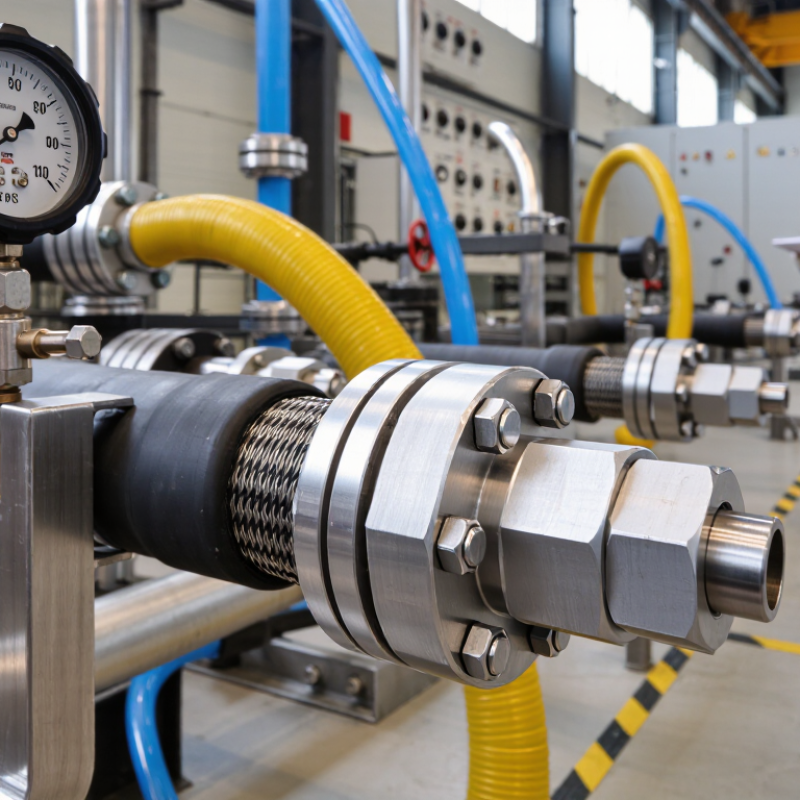
2026 How to Choose the Right Connector Hose Pipe

Classify Hose Service and Pressure Requirements Under SAE J517

A connector hose pipe should be selected for its actual service, not just its fitting size. SAE J517 classifies hydraulic hoses by construction and sets working-pressure limits by hose type and nominal bore. Its tables show why two hoses with the same inside diameter may have different ratings. For comparison, ISO 18752 lists constant-pressure classes from 3.5 to 42 MPa, approximately 508 to 6,092 psi. These are standard ratings, not a recommendation to operate at the top of a class.

Measure the peak. Record normal pressure, startup spikes, fluid temperature, and exposure to abrasion or oil. A system running at 2,800 psi, for example, needs a hose whose SAE J517 working-pressure rating covers that pressure and its pressure surges. Do not use burst pressure as the working limit. Heat changes everything. SAE J517’s pressure tables must be checked for the exact hose type and size; a larger bore does not automatically mean a higher pressure rating. I’ve seen selections based on pump pressure alone, and that shortcut misses real service conditions. Check bend radius and end fitting compatibility too, then confirm the final assembly rating.

Size the Bore Using v = 4Q/(πD²) and Required Flow Rate

2026 How to Choose the Right Connector Hose Pipe

Choose the bore from the required flow rate, not just the connector’s outside diameter. Use v = 4Q/(πD²), where v is fluid velocity, Q is flow rate, and D is the hose’s internal bore. Keep units consistent: use cubic metres per second for Q and metres for D. For example, 30 litres per minute equals 0.0005 cubic metres per second. At a target velocity of 2 metres per second, the calculated bore is about 25 millimetres. Check the actual internal diameter, since hose walls and fittings can narrow the passage.

Tips: Size for peak demand, not average use. Allow for bends, valves, and connector restrictions. A short test under operating conditions can reveal pressure loss that calculations miss.

The formula gives a starting point, not a complete selection. Higher velocity may increase noise, pressure drop, and wear, especially with viscous fluids or long hose runs. Confirm the hose’s pressure and temperature ratings, fluid compatibility, and minimum bend radius. I would also compare the calculated bore with available sizes, then check the system’s flow at its most demanding point. It is easy to trust a neat calculation too much; real installations are rarely perfectly straight.

2026: How to Choose the Right Connector Hose Pipe

Estimated minimum internal bore by required flow rate and fluid velocity

Bore is calculated using v = 4Q/(πD²), rearranged as D = √(4Q/(πv)), with flow converted from L/min to m³/s. The chart shows calculated internal bore in millimetres for flow rates of 10–40 L/min. Choose a hose with an internal bore at least as large as the calculated value, then verify pressure, temperature, fluid compatibility, and connector specifications.

Match Fittings: SAE J514 37° Flare or ISO 8434-1 24° Cone

When choosing a connector hose pipe, match the fitting’s sealing angle before comparing thread size. SAE J514 specifies a 37° flare, while ISO 8434-1 covers 24° cone connections. These figures describe the sealing surfaces, not the hose diameter. The standards provide the key geometry; they do not make differently angled fittings interchangeable. A 24° cone may look close to a 37° flare at a glance, but the contact surfaces will not seat correctly. The angles matter.

Tips: Check the fitting marking, tube outside diameter, thread form, and pressure rating. Clean the sealing faces and inspect them under good light; scratches or dents can compromise sealing. Never force the fit. A wrench can make a mismatch feel tight without creating proper contact.

In field selection, confirm the complete assembly’s rating, including hose, fitting, fluid, and temperature. SAE J514 and ISO 8434-1 identify connection designs, but operating limits depend on the specific components. Record the fitting standard and size before ordering replacements. This step can feel fussy, especially when old parts are unmarked, but guessing from thread appearance alone is unreliable. Refer to SAE J514 and ISO 8434-1 for the respective 37° and 24° connection specifications.

Check Fluid, Temperature, and Pressure Class Against ISO 18752

2026 How to Choose the Right Connector Hose Pipe

A connector hose should match the fluid, temperature, and pressure it will actually face. ISO 18752 specifies pressure classes of 7, 14, 21, 28, 35, and 42 MPa, equivalent to 70–420 bar. These are working-pressure classes, not burst-pressure targets. Choose a class above the system’s maximum operating pressure, allowing for pressure spikes during starts, stops, and valve changes. Small details matter.

Fluid compatibility is just as important. Hydraulic oil, water-glycol mixtures, and other fluids can affect hose materials differently. ISO 1817 describes laboratory methods for assessing how liquids change vulcanized rubber, including changes in volume and hardness. Use compatibility data for the exact fluid and hose construction; a generic “oil-resistant” label is not enough. If the fluid or additives change, check again.

Temperature can quietly reduce a hose’s usable pressure capacity. Compare the fluid temperature and the air around the hose with the hose assembly’s rated limits, including brief heat peaks. ISO 18752 classifies hose performance, but it does not make every construction suitable for every fluid or temperature. A pressure match may still be a poor choice if the hose runs beside a hot surface or bends tightly at the connector. Check the technical data sheet, and verify the assembly’s rating—not just the hose tube’s.

Verify Hose Assembly Test Requirements Under ISO 1402

Choosing a connector hose pipe means checking more than diameter and thread type. ISO 1402:2021 describes hydrostatic test methods for rubber and plastics hoses and assemblies. It does not set one universal proof pressure for every hose; the applicable product specification determines the required value. That distinction matters. A test at the wrong pressure can create false confidence or damage an assembly. Record the hose identification, working-pressure rating, test pressure, hold time, and observed leakage or deformation. ISO 6605:2017 also provides test methods for hydraulic hose assemblies, including pressure-related tests.

Tips: Match the test plan to the assembly’s stated service pressure and governing product specification. Use a calibrated gauge, secure the ends, and keep personnel clear while pressure rises. Check couplings for movement and inspect for bulges or seepage. Small details count.

A clean pass is useful, not magical. Hydrostatic testing does not reproduce every vibration, temperature change, or bending cycle found in service. That part is easy to overlook. I would keep the test record with the assembly’s traceability documents and repeat inspections after installation or maintenance. Avoid treating a generic “tested” label as proof that the connector suits a specific system.

2026 How to Choose the Right Connector Hose Pipe - Verify Hose Assembly Test Requirements Under ISO 1402
Selection Dimension What to Verify ISO 1402 Test or Check Information to Record Decision Guidance
Service and conveyed medium Identify the fluid or gas, concentration, operating temperature, and any cleaning or flushing agents. Hydrostatic testing evaluates pressure-related performance; it does not by itself establish chemical compatibility. Medium, concentration, temperature range, and compatibility confirmation for the hose tube and connector materials. Choose a hose assembly whose manufacturer specifies suitability for the actual service conditions.
Working pressure Establish the maximum operating pressure, including foreseeable pressure surges and vacuum conditions where relevant. Use the applicable hydrostatic proof-pressure or burst-test procedure and pressure values specified for the hose type. Maximum working pressure, required proof pressure, required burst pressure if applicable, and the source of each requirement. Do not assume one proof-pressure or burst-pressure ratio applies to every hose. Confirm values in the relevant product specification or purchase requirement.
Hose assembly and end connections Check connector type, thread or coupling standard, sealing method, material, and assembly compatibility. Test the complete hose assembly when the requirement applies to the assembled product, including its end connections. Hose identification, connection type, assembly configuration, and test-sample traceability. Verify that the connector is suitable for the system and that the assembly has been made for the specified hose construction.
Proof-pressure test Confirm the required test pressure, pressure-hold duration, test medium, and test conditions before testing. ISO 1402 provides hydrostatic test methods; the applicable product specification or agreement defines the required test conditions and acceptance criteria. Test pressure, hold time, medium, temperature where specified, and observed leakage or damage. Accept the assembly only when it meets the stated product or contract criteria. Do not substitute an assumed universal value.
Burst-pressure test Determine whether a destructive burst test is required for qualification, verification, or another defined purpose. Use the ISO 1402 hydrostatic burst-test method when a burst test is specified. Required minimum burst pressure, sample details, test conditions, achieved pressure, and failure location or mode. A burst test is destructive and should be performed on designated samples, not on assemblies intended for service.
Dimensional change under pressure Check whether length change, expansion, or other dimensional behavior is important for the application. Apply the relevant ISO 1402 measurement procedure when required by the hose specification or test plan. Initial measurement, measurement under the specified pressure, and the calculated change. Set acceptable limits from the applicable product specification; dimensional limits are not universal across hose types.
Installation conditions Review minimum bend radius, routing, movement, abrasion exposure, and support requirements. Hydrostatic pressure testing does not replace checks for installation suitability or service-life factors. Required bend radius, installation route, movement or vibration conditions, and protective measures. Select a hose assembly that can be installed without kinking, twisting, excessive strain, or violation of its specified bend radius.
Test preparation and safety Inspect the sample and connections, secure the test setup, and remove trapped air where required by the procedure. Conduct hydrostatic testing using the specified procedure and suitable equipment; follow the test facility’s safety controls. Equipment identification, calibration status, test setup, operator, date, and any deviations from the procedure. Use a controlled test area and keep personnel clear of pressurized components. Follow applicable workplace safety requirements.
Test report and traceability Ensure results can be linked to the hose assembly, test requirement, and applicable specification. Record the method and test conditions used so the results can be reviewed against the stated acceptance criteria. Assembly or batch identification, applicable ISO 1402 edition, test type, conditions, results, acceptance decision, and report date. Require a complete report when verification or documentation is part of the purchase or quality requirements.
Key requirement check ISO 1402 specifies hydrostatic test methods for rubber and plastics hoses and hose assemblies. It should not be treated as a single universal schedule of pressure values or acceptance limits; confirm those requirements in the applicable hose product specification, project documents, or purchase agreement.