Industrial Machinery Company

How to Choose the Best Rectangular Fly Banners?

Choosing the right Fly Banners Rectangular starts with the place they will be used. A banner beside a busy road needs different dimensions from one displayed inside a trade show booth. Think about viewing distance, available space, and how people will approach it. A tall design can attract attention, but oversized graphics may feel crowded. That matters.

Fabric and construction affect appearance and handling. Polyester is commonly used because it is lightweight and accepts printed graphics well. Check the fabric weight, seam finishing, and whether the print is single- or double-sided. A double-sided option can improve visibility from different directions, though it may cost more and add weight. Small details count. Ask the supplier for material specifications and a proof before approving an order.

The pole and base deserve equal attention. Choose a base that suits the surface, such as a ground spike for soft soil or a cross base for hard flooring. Outdoor placement brings extra uncertainty: gusts can twist fabric, and no banner is suitable for every weather condition. Follow the manufacturer’s setup guidance and take the display down when conditions become unsuitable. I would not choose by price alone; durability and clear printing matter over repeated use. Still, there is no perfect setup for every event. This guide explains how to compare banner size, materials, printing, hardware, and practical costs, so you can make a choice that fits your display rather than simply buying the largest option.
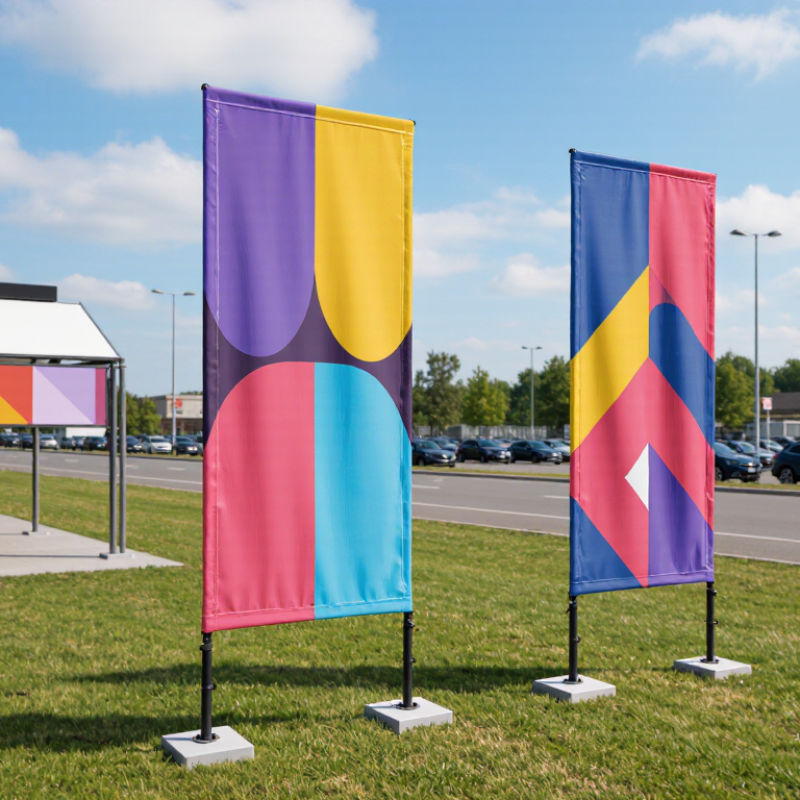
How to Choose the Best Rectangular Fly Banners?

What Rectangular Fly Banners Are and How They Work

A rectangular fly banner is a fabric sign with a straight-edged shape, usually mounted on a flexible pole. Its flat profile gives artwork a broad, readable area for names, directions, or event messages. Unlike a rigid board, the fabric can move when air passes over it. That motion can draw attention, though it may also make small text harder to read.

The pole supports the banner through a sewn sleeve or attachment points, while a base keeps the assembly upright. Bases may be designed for grass, sand, or hard surfaces, so the mounting choice matters as much as the printed design. On pavement, a weighted base can help prevent tipping. Check that the pole is fully seated and the fabric is not twisted. Small setup errors show.

In light wind, the banner may flutter gently and remain visible from different angles. Strong gusts can strain the pole, pull at seams, or shift a poorly secured base. A wider print area is not automatically better; distant viewers need large lettering and clear contrast. It is easy to overestimate how much detail people can read while walking past. Allow space around the banner, and consider how nearby signs or buildings may block its view.

Which Banner Size and Shape Fit Your Display Space

Choose a rectangular fly banner by measuring the full display area, including its base, rather than the printed panel alone. In a narrow aisle, a slimmer banner can stay visible without crowding neighboring displays; in an open entrance, a wider panel may be easier to notice from an angle. Measure overhead clearance, too. Measure it first. The U.S. Access Board’s ADA Standards specify a 36-inch minimum clear width for accessible routes, a useful planning benchmark, though venues may require more. Keep the stand and passersby outside that clear path.

Use the UFI Global Exhibition Barometer, 34th edition (January 2024), as market context: it reported that exhibition-industry turnover in 2023 averaged about 20% above 2019 levels. That figure does not prescribe banner dimensions, but busy events make legibility and placement worth careful testing. Match the banner’s height to viewing distance, then check that its message remains readable at eye level. Wind changes everything. For outdoor displays, assess exposure and use a stand rated for the conditions; a tall panel can catch gusts even when its footprint looks small. I would mock up the outline with tape before ordering. It is not glamorous, and measurements can still be imperfect, but it reveals awkward corners and blocked sightlines early.

How to Compare Banner Fabric, Printing, and Hardware

For a rectangular fly banner, compare fabric by weight, weave, and finish—not color alone. Polyester is light and packs neatly, while a tighter weave often gives sharper lettering. Ask for fabric weight in g/m² and test evidence for tear strength and colorfastness. A coated fabric may resist light rain, but coating can change its drape. Small detail, big difference.

Printing needs to suit the fabric. Dye sublimation can place color through polyester fibers, helping graphics stay flexible; UV printing may suit some coated materials, but results depend on ink and surface. Request a sample, then inspect it outdoors: tiny text can disappear in glare. The Outdoor Advertising Association of America reported U.S. out-of-home advertising revenue of $9.1 billion in 2023. That figure reflects the value of outdoor placements, not proof that one banner material performs best. I still find this distinction easy to overlook.

Hardware matters just as much. Compare pole sections, joint fit, base footprint, and packed weight. Fiberglass poles flex; aluminum can feel more rigid, though construction varies. Match the base to the surface, and follow the supplier’s wind-use guidance. A heavier base is not a guarantee of stability in gusts. Ask how the banner, pole, and base were tested together. Test it on your actual pavement, too.

How Location and Weather Affect Your Banner Choice

How to Choose the Best Rectangular Fly Banners?

How Location and Weather Affect Your Banner Choice

A banner that works in a sheltered shop entrance may struggle on an exposed roadside. Check the site’s typical wind, rain, and sun before choosing its fabric, pole, and base. NOAA’s 1991–2020 U.S. Climate Normals provide local monthly climate data, including precipitation and wind information. They are a useful starting point, though nearby buildings can change conditions at ground level. Small details matter.

Wind deserves particular attention. The U.S. National Weather Service’s Beaufort wind scale describes 19–24 mph as a “fresh breeze” and 25–31 mph as a “strong breeze.” A tall banner can catch gusts even when the average wind seems mild. For open lots or coastal sites, consider a sturdier base and check the hardware maker’s stated operating limits.

In wet or sunny locations, ask about water resistance and UV durability; printed colors can fade with prolonged sun exposure. One common mistake is choosing by appearance alone. I’d also observe the actual site at different times of day—though a brief visit cannot predict every gust.

How to Match a Banner Package to Your Budget and Needs

A rectangular fly banner package should fit the job, not simply offer the most accessories. Start with the display location: a narrow pavement entrance may need a compact banner, while an open event area can benefit from a taller profile. Check the listed banner dimensions and packed size before ordering. A stronger base may be worth the extra cost if the surface is uneven or the banner will be moved often. Still, no base makes outdoor use risk-free in gusty conditions.

Tips: Match the base to the surface. Compare single-sided and double-sided printing, too. Double-sided options can help when people approach from both directions, but they may not suit every budget. Ask what the package includes: pole, base, carry bag, and replacement parts can affect the real cost.

For occasional events, a basic package with a reusable frame may be the practical choice. For frequent setup, prioritize sturdy fittings and a bag that protects the fabric in transit. Look closely at artwork requirements; a low-cost package can become frustrating if the finished design needs unexpected adjustments. It is easy to overthink the print finish. Clear lettering and strong contrast usually matter more at a distance than tiny details. Compare total cost, expected use, and storage space before deciding.