How to Choose the Best Hydrocell Golf Cart Battery?
Choosing the best Hydrocell Golf Cart Battery starts with the cart, not the product label. Check the manufacturer’s manual for the required voltage, battery dimensions, terminal arrangement, and recommended capacity. A battery that looks suitable may not fit beneath the seat or connect safely to the existing cables. Small details matter.
Range matters too. Think about your usual route, passenger load, hills, and how often you can recharge. A flat course and occasional rides create different demands from long days on steep paths. Compare the battery’s published specifications with your real use, and confirm that your charger is compatible. Don’t guess. If the manual is unclear, ask the cart maker or a qualified battery specialist before buying.
A dependable choice also depends on more than performance claims. Review the warranty terms, installation guidance, maintenance requirements, and availability of customer support. Check whether the seller provides clear specifications rather than relying on vague promises. I would not assume that a higher price guarantees a better match; fit and verified compatibility come first. Nor should a single range estimate settle the decision, since terrain, temperature, and driving habits can change results. This guide will help you compare those practical factors and ask better questions before purchase. The right choice should work with your cart, your routine, and your charging setup—not just look impressive on a product page.
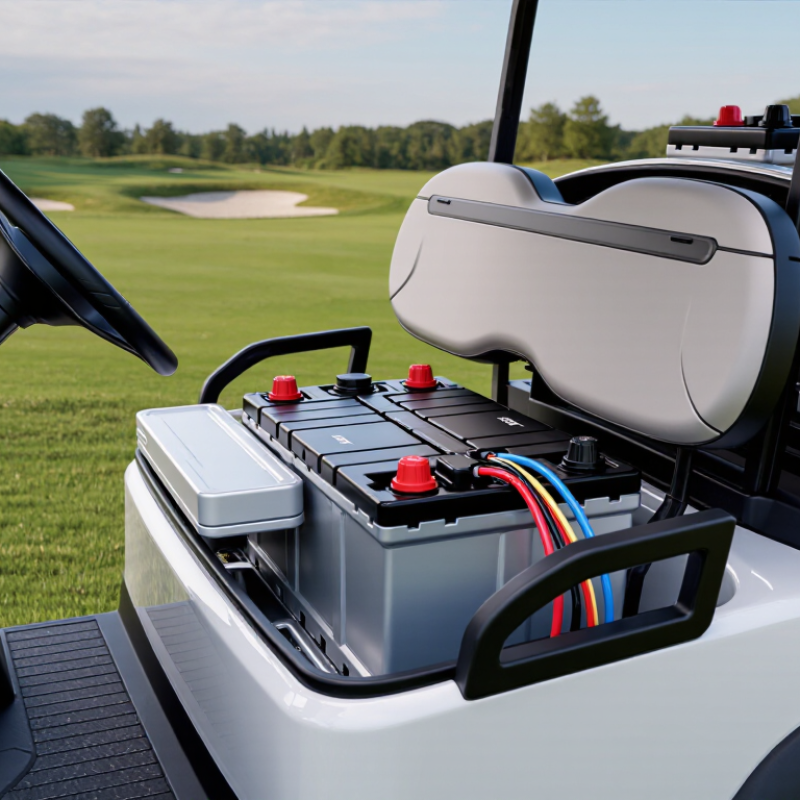
Identify Your Golf Cart’s Voltage and Battery Requirements
A golf cart’s voltage is the first requirement to confirm. Many carts use 36- or 48-volt systems, but never assume yours matches a common setup. Check the owner’s manual, the labels on the existing batteries, and the cart’s wiring diagram if available. Battery count can offer a clue: six 6-volt batteries may form a 36-volt pack. Still, previous repairs can change the setup. When uncertain, have a qualified technician verify the pack voltage before buying.
Tips: Take a clear photo of the battery layout. Note each battery’s voltage, terminal position, and cable connections. Measure the tray, too. Small differences can prevent a new battery from fitting.
Voltage is only part of the match. Check the required battery chemistry and confirm that the charger is compatible with it. Then consider capacity, often listed in amp-hours. Longer routes, hills, and extra passengers can increase energy demands. Compare those needs with the battery’s specifications, not just its advertised range. I would recheck the measurements before ordering; it is an easy detail to overlook. The cart manual or a service professional can help resolve conflicting information.
Understand Hydrocell Battery Types and Key Specifications
Hydrocell battery descriptions can refer to different designs, so check the chemistry on the specification label rather than relying on the name alone. Golf carts commonly use flooded lead-acid, AGM, gel, or lithium batteries. Flooded batteries need regular water-level checks and upright installation. AGM and gel models are sealed, but they still require a compatible charger. Lithium batteries are lighter and often provide more usable capacity, though they may need a battery-management system. Small differences matter.
Compare the battery’s voltage with the cart’s system voltage; a typical pack may use several batteries connected together. Check amp-hour capacity and the rating period, since figures measured over different intervals are not directly comparable. Also confirm case dimensions, terminal layout, and cable reach before ordering. A battery that almost fits can still create unsafe connections. Review the manufacturer’s cycle-life and temperature limits, too. These figures depend on how deeply the battery is discharged and how it is charged. I would not choose by capacity alone. A larger rating may add weight, cost, or charging time, and the published number may not match real driving conditions.
How to Choose a Golf Cart Battery
Typical cycle-life ranges by battery chemistry
Cycle life is an approximate range, not a guarantee; depth of discharge, temperature, charging, and maintenance all affect battery life. “Hydrocell” may be used differently by sellers, so check the product specification sheet to confirm the chemistry, voltage, and capacity (Ah).
Compare Capacity, Range, and Expected Operating Conditions
A battery’s amp-hour rating is only useful when matched to system voltage and daily demand. For example, a 48-volt, 100-Ah pack stores about 4.8 kWh nominally; actual usable energy varies with battery chemistry, age, and discharge limits. Estimate energy needs from your real route, not a brochure range. Count passengers, cargo, hills, repeated stops, and any accessories. A cart carrying four adults up a long slope needs more reserve than one cruising on flat paths. Keep a margin for the trip home. That margin is easy to underestimate.
Temperature matters, too. The AAA’s 2019 Electric Vehicle Range Testing report found range fell 12% at 20°F without cabin heating, and 41% with heating. Those figures are not golf-cart predictions, but they show why cold-weather planning matters. Heat, steep grades, low tire pressure, and frequent acceleration can also shorten a cart’s practical range. Compare batteries under the conditions you expect: typical load, route length, terrain, and seasonal temperatures. Ask how capacity was rated, and whether the quoted range assumes ideal conditions. Real use is less tidy. Track a few full workdays, including the longest route, then choose capacity that covers it without routinely running near empty.
How to Choose the Best Hydrocell Golf Cart Battery? — Compare Capacity, Range, and Expected Operating Conditions | Battery configuration | Nominal capacity | Nominal energy | Planning assumption for usable energy | Estimated range at 200 Wh per mile | Best suited operating conditions | Key considerations |
| 36 V flooded lead-acid | 170 Ah | 6.12 kWh | About 50% of nominal energy, or 3.06 kWh, to limit deep discharge | About 15 miles | Moderate daily use on relatively level routes, with access to routine charging and battery maintenance. | Requires periodic watering and terminal checks. Range can fall with heavy loads, steep hills, cold weather, or infrequent maintenance. |
| 48 V lead-acid | 150 Ah | 7.20 kWh | About 50% of nominal energy, or 3.60 kWh, to limit deep discharge | About 18 miles | Regular use on mixed terrain when the cart can be recharged after daily operation. | Flooded versions need watering; sealed versions generally need less routine maintenance. Battery weight and charge time should be considered. |
| 48 V lithium iron phosphate (LiFePO4) | 100 Ah | 4.80 kWh | About 80% of nominal energy, or 3.84 kWh, as a planning estimate | About 19 miles | Frequent use, longer operating days, or applications where lower battery weight and reduced routine maintenance are priorities. | Confirm charger compatibility and the battery management system’s limits. Charging below freezing may be restricted unless the battery has suitable cold-weather protection. |
| How to interpret the estimates: Nominal energy is calculated as voltage × amp-hours. Estimated range uses the stated usable-energy planning assumptions divided by an illustrative consumption rate of 200 Wh per mile. Actual range depends on the cart, passenger and cargo weight, tires, speed, hills, surface, temperature, battery age, and driving style. Check the battery and cart manufacturers’ specifications before purchase. |
Check Battery Fit, Connections, Charging, and Safety Features
Choosing a golf cart battery starts with the available space, not just the advertised capacity. Measure the tray’s length, width, and height, including brackets and nearby cables. Measure twice. A battery that almost fits may press against a panel or shift over bumps. Check the required voltage and capacity against the cart’s manual, and leave room for secure hold-downs.
Connections deserve a close look. Confirm terminal position and polarity before buying; reversed or stretched cables can create serious problems. Check whether the existing cables reach without bending sharply, and inspect them for corrosion, cracked insulation, or loose ends. Small details matter. I’d avoid assuming that a familiar-looking terminal will match—the layout can differ between batteries.
Charging requirements depend on battery chemistry and system voltage. Verify that the charger is compatible, rather than relying on a plug that happens to fit. Review the battery documentation for protections such as overcharge, overcurrent, and temperature monitoring. Look for insulated terminals and a sturdy case, too. If the specifications are unclear, ask a qualified technician to check the setup before installation. A tidy fit can still be wrong.
Evaluate Warranty, Maintenance Needs, and Long-Term Cost
A warranty is only useful when its limits match your riding habits. Check the coverage period, cycle or usage limits, labor costs, and whether capacity loss is included. Ask how a claim is tested; a battery that still powers a cart may nevertheless have lost useful range. Keep the purchase receipt and record charging or service issues. Small detail. It can save a dispute later.
Maintenance changes the real cost. Flooded lead-acid batteries need regular water-level checks and clean terminals; sealed designs reduce those tasks but still need correct charging and ventilation. A missed watering check can shorten service life. I would not assume a “maintenance-free” label means zero inspection. Follow the manual and inspect cables for corrosion.
Compare total ownership cost, not just the price tag: purchase, charger compatibility, routine care, expected replacement, and downtime. BloombergNEF’s 2024 Lithium-Ion Battery Price Survey reported average global lithium-ion pack prices of $115 per kilowatt-hour, down 20% from 2023. That is useful market context, not a golf-cart quote; retail prices and warranties differ. Estimate cost per year using the expected service life, then compare like-for-like capacity and warranty terms. A cheaper battery may look sensible at checkout. It may not stay that way.