10 Best Smart Street Lights for Global Buyers
Choosing a Smart Street Light is about more than replacing an old lamp. Buyers need reliable illumination, manageable energy use, and controls that suit real streets. A fixture above a narrow residential road may not work well on a wide, busy avenue. Details matter.
This guide compares 10 smart street lights for global buyers, with practical factors in view. These include LED output, color temperature, dimming options, sensor capability, remote monitoring, and maintenance access. Housing materials and ingress protection ratings also matter, especially where fixtures face dust, heavy rain, coastal air, or large temperature swings. A connected control system can help operators adjust schedules and identify faults, but its value depends on dependable communications and usable software. Fancy dashboards are not enough.
There is no universal best choice. Product performance depends on pole height, road layout, mounting hardware, local grid conditions, and the lighting plan. Buyers should review manufacturer specifications and request photometric data for their intended installation. They should also confirm compatibility with existing controls and have qualified local professionals assess applicable technical requirements. These checks can take time. Skipping them can cost more later.
The selections ahead are intended as a starting point, not a substitute for project-specific evaluation. Some products may suit large municipal networks; others may fit smaller sites or phased upgrades. We highlight useful strengths while noting trade-offs, because a feature list cannot tell the whole story. Consider the street, the maintenance team, and the long-term operating budget before choosing.
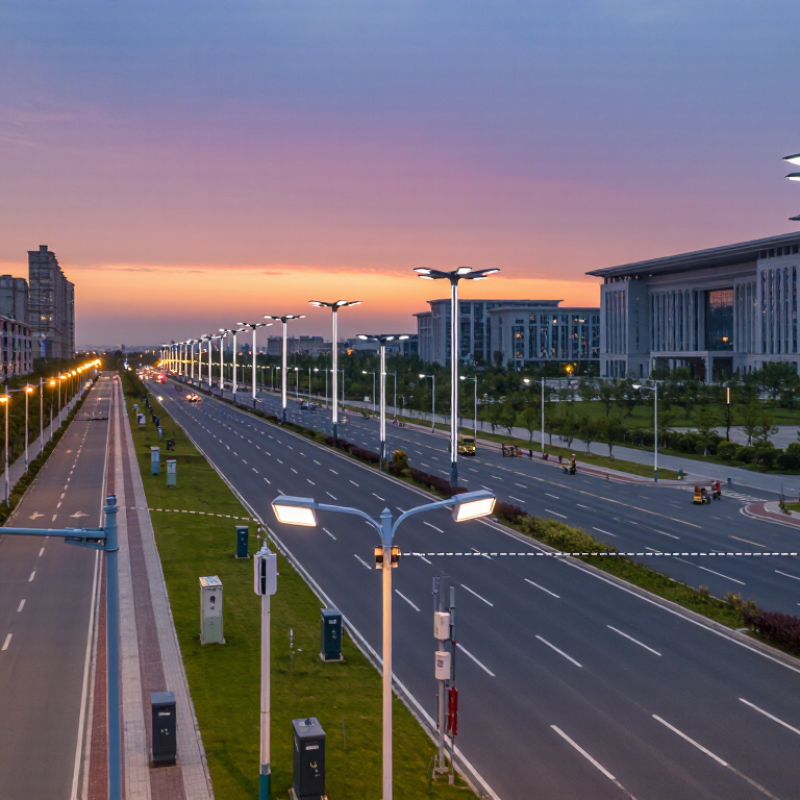
Smart Street-Light Basics: LEDs, Sensors, Networks, and Adaptive Dimming
Smart street lights begin with efficient LED fixtures, but the lamp is only one part of the system. Optics should direct light onto roads and sidewalks, limiting glare at windows and dark gaps between poles. Color temperature, mounting height, and pole spacing affect visibility as much as wattage. Small details matter. On a wet road, reflections can make an overly bright installation feel harsher, not safer. Photometric plans and nighttime checks help buyers verify real conditions before scaling a project.
Sensors add context to the lighting plan. Motion or ambient-light sensors can trigger measured changes, while schedules provide a dependable fallback. Networks let operators monitor faults, compare energy use, and adjust groups of lights remotely. Connectivity choices should match coverage, maintenance skills, and the cost of replacing gateways. Not every street needs constant data. Adaptive dimming can lower output during quiet hours, then raise it when activity returns, if sensor placement is reliable. That caveat matters. Trees, parked trucks, and winter weather may confuse sensors, so pilot zones and manual review are worth the extra effort.
Buyer Benchmarks: IP66 Ingress Protection and IK08 Impact Resistance
For global buyers, IP66 and IK08 are useful screening benchmarks for smart street lights. IP66 indicates a dust-tight enclosure and protection against powerful water jets. It does not mean the luminaire can be submerged. IK08 corresponds to an impact energy of five joules, tested under defined conditions. These ratings matter on roads exposed to windblown grit, heavy rain, and occasional knocks from maintenance equipment.
Check the test report against the exact luminaire configuration, not just a product-family brochure. Ask whether the rating covers the housing, optical cover, cable glands, and connected compartments. A well-sealed body can still be compromised by a poorly fitted connector. Look for test details, laboratory identification, and the applicable IEC standards. Small documents matter.
Installation deserves equal attention. Confirm that seals remain seated after opening, and that specified cable entries are used in the field. IP66 does not remove the need for careful maintenance. IK08 also cannot promise protection from every impact; a falling branch may strike an exposed edge differently than a standardized test tool. That distinction is easy to miss. In my view, buyers should treat ratings as verifiable evidence, not as a substitute for checking construction and service procedures. Even good specifications can leave questions.
Comparing 10 Global Picks by Lumens, CCT (K), and Dimming Range
A useful global shortlist compares light output with street width, mounting height, and control range—not lumens alone. These ten application-based picks show practical planning bands, not guaranteed product specifications: pedestrian paths, 3,000–6,000 lumens, 2,700–3,000 K, dimming from 10–100%; residential streets, 5,000–9,000 lumens, 3,000 K, 10–100%; collector roads, 8,000–15,000 lumens, 3,000–4,000 K, 20–100%; major arterials, 15,000–30,000 lumens, 3,000–4,000 K, 20–100%; high-mast junctions, 30,000–60,000 lumens, around 4,000 K, 10–100%.
For plazas, consider 4,000–10,000 lumens at 2,700–3,000 K, with 10–100% dimming. Coastal roads may suit 6,000–14,000 lumens at 2,700–3,000 K, dimming from 20–100%. Industrial access roads often need 12,000–25,000 lumens at 4,000–5,000 K, with 10–100% control. Solar hybrid units commonly fall near 3,000–10,000 lumens, 3,000–4,000 K, and 30–100%; battery limits matter. Adaptive smart fixtures can span 8,000–25,000 lumens at 3,000–4,000 K, with control from near-off to full output. Check the actual driver and control protocol.
The U.S. Department of Energy’s 2019 solid-state lighting forecast estimated potential annual savings of 569 TWh by 2035 against its baseline. That scale is compelling, but a lumen ranking can mislead: optics, spacing, and measured road conditions change results. IES roadway-lighting guidance supports evaluating the illuminated surface, not just fixture output. Request photometric files and verify dimming behavior at low levels; published ranges do not always reveal flicker or minimum stable output.
10 Best Smart Street Lights for Global Buyers
Compare representative lumen outputs, correlated color temperatures (CCT), and dimming ranges across common street-light specifications.
These anonymized specification points illustrate commonly available product configurations, not verified specifications for ten individual products. Actual output, CCT, and dimming capability vary by model; check manufacturer datasheets before purchasing.
Regional Fit: 50/60-Hz Grids, Voltage, Certifications, and Lifecycle Cost
Regional fit can decide whether a smart street light performs reliably or becomes a maintenance burden. Check supply frequency, not just the voltage on a quotation. A 50-Hz or 60-Hz grid requires compatible LED drivers and control gear. The datasheet should state supported input ranges clearly. Small detail. Confirm the actual service voltage at the pole, since nominal values vary by market and may fluctuate along long feeder lines. Ask how the driver handles the site’s voltage range, surges, brownouts, and temperature changes.
Certification needs local verification. Request test reports and conformity documents recognized in the destination market. Match the model numbers and options exactly. A certificate for one driver or photocell may not cover another configuration. Don’t assume. Before ordering at scale, pilot a few poles through full night cycles and review dimming schedules, communications, and fault logs. Compare lifecycle cost, not purchase price alone: include energy use, component life, warranty terms, maintenance access, and network fees. A cheaper fitting may cost more if crews need a lift truck for frequent repairs. These estimates are imperfect; local labor costs and electricity rates can change the result.